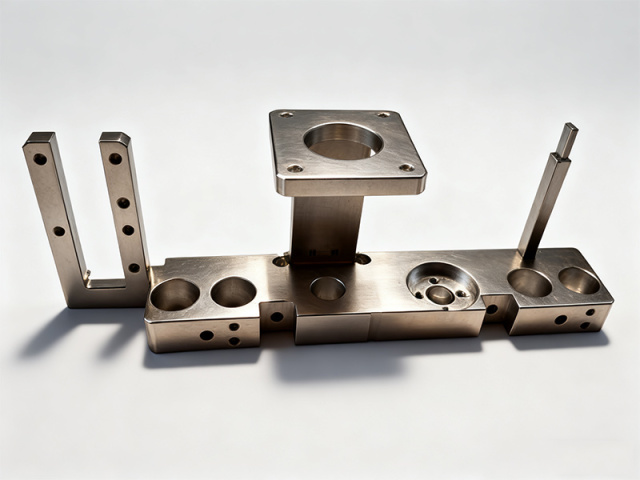
Transfer Block Overview
A transfer block is usually the fixed part that carries a fluid or gas path between two components of a medical device assembly, and it gives the parts around it something accurate to register against. Bores and milled faces route the medium, threaded holes hold the mating fittings, and the positional relationship between all of them decides how the rest of the assembly lines up.
We machine this block to your drawing rather than to a catalogue number. Our precision cnc machining services start from the file you send — a 2D drawing, a 3D model, or both — and the geometry, hole positions and thread forms in that file are what the finished part carries. If the drawing shows a positional tolerance, that tolerance is what we work to.
Because these are precision machined parts rather than stock hardware, the drawing is also the specification. Two blocks that look the same on a bench can behave very differently in an assembly if one bore sits off station, so the datums and the relationships between features get the closest attention.
Most buyers who order this block are medical device manufacturers, contract manufacturers building for them, and engineering teams validating a new design. Usually they need a repeatable part rather than a one-off: the first block proves the design, and the batches that follow have to fit the same way.
Tell us how the part functions in the assembly as well as sending the drawing. That context lets us flag anything ambiguous before machining starts — a tolerance that cannot be held under the finish you specified, or a thread callout that does not match the mating fitting.

Production Strengths
- Drawn to your file: bores, counterbores, milled faces and tapped holes all follow the geometry you supply, including the positional relationships between them.
- Production machines, not a manual mill: our precision cnc machining services cover roughing and finish machining on MAZAK and DMG Mori 3-axis machining centres.
- Grinding where it counts: any feature the drawing marks with a visible positional tolerance is finished on a precision grinder instead of being left to the milling cut.
- Measured before it ships: Zeiss 3D coordinate measurement, plug gauges and thread gauges confirm the finished geometry.
- One production chain: as a cnc machining parts manufacturer we keep machining, heat treatment, finishing and inspection under one roof, so the block does not travel between subcontractors and lose dimensional control on the way.
- Assembly-level fit: as a cnc machining supplier we work from what the block does in the device as well as from the drawing, so the features that carry the alignment get the grinding and measurement effort.
Machining & Inspection Flow
- Drawing and model review — our precision cnc machining services team reads the drawing, the 3D model and any assembly notes, confirms material, finish and heat treatment, and raises anything that cannot be produced as specified.
- Rough machining with allowance — the block is roughed on a MAZAK or DMG Mori 3-axis machining centre, leaving stock on every precision hole and threaded hole.
- Heat treatment — the aluminium grade determines the treatment applied at this stage; on this part annealing is used to remove internal stress before the final cuts.
- Finish machining — all precision holes and threaded holes are cut to the drawing after heat treatment, so the precision machined parts leave this stage with the hole pattern locked to the drawing's datums.
- Precision grinding — where the drawing shows a visible positional tolerance, that feature is ground on a precision grinder rather than left to the milling cut.
- Surface treatment — the agreed anodizing or nickel plating is applied once the geometry is final.
- Dimensional verification — Zeiss 3D coordinate measurement checks hole position and feature relationships, plug gauges confirm bore diameters and thread gauges confirm thread form, all under our ISO 9001 quality management system.
- Final review and packing — machined faces and threads are checked for burrs and handling marks, then packed so they reach you undamaged.
Material Options
Material choice decides what the block can do, how it finishes and how long it lasts in service, so it is worth settling early rather than leaving it to the machine shop.
Aluminium 6063 is the workhorse for a block like this. It machines cleanly, holds its shape in thin sections and takes anodizing evenly, which is why it is the usual choice when the part needs to be light, rigid and finished to an even colour.
Aluminium 7075 is the higher-strength route. Where the block carries a load, supports a fitting in bending, or is thinned down to save weight, 7075 holds stiffness that 6063 cannot match.
SUS304 stainless steel suits blocks where corrosion resistance matters more than weight. SUS316L goes a step further, resisting pitting and chloride attack better than 304, so it is the grade to pick where the part is cleaned often or meets aggressive media during sterilisation and handling.
Copper is specified when the block has to conduct heat or current as well as locate other components. It machines well but is softer than the steels, so threaded features and machined faces benefit from more careful handling at the assembly station.
If your assembly has competing requirements — light and stiff, or corrosion resistant and thermally conductive — tell us which property matters most. We build the custom cnc machining route around the grade you choose: heat treatment steps are matched to that grade rather than applied generically, and grinding is reserved for features where it genuinely improves the result.
One note before you send the file: "aluminium" on its own is not enough to work from. Put the exact grade, any temper you have, and the finish you expect on the drawing.
Surface & Heat Treatment
- Sandblasted clear anodizing: a satin, natural-metal finish with an oxide layer that resists corrosion and handling wear, and the usual choice when the block should look like machined aluminium.
- Sandblasted black anodizing: the same protective layer in black, used where the assembly calls for a dark, low-reflectance surface.
- Hard anodizing: a harder, denser oxide layer for faces that rub, slide or are handled constantly during assembly and cleaning.
- Nickel plating: an electroplated layer that adds wear and corrosion resistance and leaves a bright, easily cleaned surface, often specified on copper and steel parts in the same assembly.
- Annealing to remove internal stress: applied before the final machining cuts so the block does not move after its last operation.
- Finish and dimension planned together: because these are precision machined parts, the coating and the metal dimension have to be decided as one. Tell us if a bore or face must still hold its drawing size after anodizing or plating.
- Matched finishes across an assembly: if a mating component is already nickel plated or anodized, say so — as a cnc machining supplier we regularly match finishes so the parts in one assembly look and wear alike.
Specifications
| Specification |
Detail |
| Materials |
Aluminium 6063, Aluminium 7075, SUS304, SUS316L, copper |
| Machining equipment |
3-axis machining centre (MAZAK, DMG Mori) and precision grinder |
| Machining route |
Rough machining with allowance, heat treatment, then finish machining of all precision and threaded holes to drawing |
| Critical features |
Positional tolerances on the drawing finished by precision grinding |
| Surface treatments |
Sandblasted clear anodizing, sandblasted black anodizing, hard anodizing, nickel plating |
| Heat treatment |
Annealing to remove internal stress |
| Inspection equipment |
Zeiss 3D coordinate measuring machine, plug gauges, thread gauges |
| Machining cycle |
3-15 days, depending on part complexity and order size |
| Customization |
Machined to your drawing and 3D model |
Ordering & Delivery
- Send your drawing and 3D model together with the material grade, surface finish, any heat treatment requirement, and the quantity you expect to run.
- Engineering review — as a cnc machining parts manufacturer we read the file before quoting and raise anything that would change the part's fit, cost or timing, from a tolerance that is hard to hold under the specified finish to a thread callout that does not match the mating fitting.
- Quotation — you receive pricing for the finished part, covering material, machining, heat treatment, surface finishing and inspection.
- Confirmation — production is scheduled once the drawing, material grade and finish are agreed, and the custom cnc machining route is programmed from your own file.
- Production time — the machining cycle is 3-15 days depending on part complexity and order size, and it covers the full route: 3-axis machining, heat treatment, surface finishing and dimensional inspection. Across our production generally, we produce within 7-15 days depending on how demanding your requirement is, and special materials take about one month. We confirm the schedule for your batch with the quotation.
- Packing — parts are packed to protect machined faces and threads in transit. If you need individual wrapping, tray packing or part marking, agree it when you place the order.
- Shipping and paperwork — confirm the delivery terms, destination and the documents your team needs with your sales contact before dispatch.
- Repeat orders — quote the drawing revision you want when you re-order. As a cnc machining supplier we keep the material grade, finish and inspection route used for your previous batch on file.
Handling & Pre-Assembly Storage
- Keep the block in the packing it arrives in, and keep the batch reference with it. If your goods-in team opens the wrapping to inspect the parts, close it again afterwards rather than leaving the blocks loose on a bench.
- Do not tip anodized or plated blocks into a shared bin. Sandblasted anodizing and nickel plating mark when parts knock against one another, and a mark on a sealing or locating face is a problem you did not have at goods-in.
- Treat ground features as reference surfaces, not clamping points. Where the drawing carries a positional tolerance, that face was ground to hold it; clamp on the outer profile or in soft jaws, and lift the block rather than sliding it across a steel bench.
- Keep copper blocks apart from steel parts in stores. Copper is the softest of the five grades used on this part and bruises or scratches easily, so give it its own wrapping and its own space.
- Leave the thread protection in place until the block reaches the assembly station. Start the mating fitting by hand first; if it needs force, stop and check the fitting and the drawing callout instead of driving it in.
- Clean with a soft, lint-free cloth. Abrasive pads, wire brushes and metal scrapers strip the coating off anodized and plated surfaces, and a metal tool dragged through a precision bore changes the very dimension it was measured for.
- Store dry, indoors and out of direct sunlight, and avoid stacking heavy parts on top of a thin block. If a batch sits in stores for several months, re-check the bores and threads before fitting and return the parts to their wrapping between operations.
- Leave the wrapping on until the moment of fitting. Setting precision machined parts down on a machined face at the assembly station is how most damage between goods-in and assembly actually happens.
Scale & Supply Capability
Suntontop is a precision machining factory based in Shenzhen, China, founded in 2014 and now 300 people strong, with more than ten years of hands-on processing practice. We run a sufficient number of CNC and other processing machines, so capacity can be adjusted flexibly to match order volumes, and every order is produced to your drawings under full-process quality control supported by more than 100 sets of inspection equipment. We support OEM and ODM custom manufacturing for machinery manufacturers and industrial distributors across Europe, the Americas, Southeast Asia and Central Asia, with on-time delivery and responsible after-sales support.
FAQ
Q1. Which materials can I choose for the transfer block?
Five grades cover most medical work: Aluminium 6063, Aluminium 7075, SUS304 and SUS316L stainless steel, and copper. As a rule, aluminium carries most transfer blocks, stainless is the answer where the part is cleaned often or meets aggressive media, and copper is specified when the block has to conduct heat or current as well as locate other components. Send the drawing with a note on what the part does if you would like a recommendation.
Q2. Can you customize the surface finish to suit a specific medical device requirement?
Yes. Sandblasted clear anodizing, sandblasted black anodizing, hard anodizing and nickel plating are all available on this block, and the finish can be matched to the mating components in the same assembly. Tell us whether the finish is there for corrosion protection, wear resistance or appearance, and whether any bore or face has to hold its metal dimension after the coating is applied — that is the detail most often worth settling before machining starts.
Q3. How do you make sure the finished block matches our drawing?
The order of operations does most of the work. All precision and threaded holes are left until after heat treatment, so annealing cannot move them, and any feature with a visible positional tolerance is ground rather than milled. The finished geometry is then measured — Zeiss 3D coordinate measurement for hole position and feature relationships, plug gauges for bore diameters, thread gauges for thread form — and those results stay with the batch.
Q4. Is this a standard part, or is it machined to order?
It is machined to order. Every block is a custom cnc machining job programmed from the buyer's own drawing and 3D model, which is why the file has to come with the enquiry. There is no catalogue version to compare against: the value of the part is that its bores, faces and threads land exactly where your assembly expects them.
Q5. Where does the transfer block sit in a medical device assembly?
It is usually the fixed interface between two stages of a fluid or gas path — the part the surrounding components register against. Its bores and milled faces route the medium, its threaded holes take the mating fittings, and its own mounting features hold it to the frame or manifold. Because everything around it locates on it, the hole pattern and the face positions matter more than the outer profile.
Q6. What happens if a dimension is out of tolerance or a thread will not run?
Tell us before you force the fit. Send the measurement and the drawing reference, and we will check the inspection result and the gauge used for that batch, then work out with you whether the cause sits in the machining, in the drawing callout, or in the way the part is being fitted. A thread that has to be forced usually means something is being asked of it that the callout does not describe.
Q7. How should the block be handled before it goes into the assembly?
Keep it in its transit packing until the assembly station is ready. Anodized and plated surfaces mark when parts are shaken together in a bin, and ground faces lose their reference if they are clamped directly in a vice. Wipe the machined surfaces with a clean, lint-free cloth, check that the threads run free by hand, and leave the protective wrapping on until the block is actually being fitted.